




Why this question matters in 2026
Recent enterprise launches are moving beyond chat into systems that take actions. Salesforce’s September 2026 AI Harness announcement places business context, controls and action alongside reasoning. That is an announcement about architecture, not proof that every small business needs an autonomous agent.
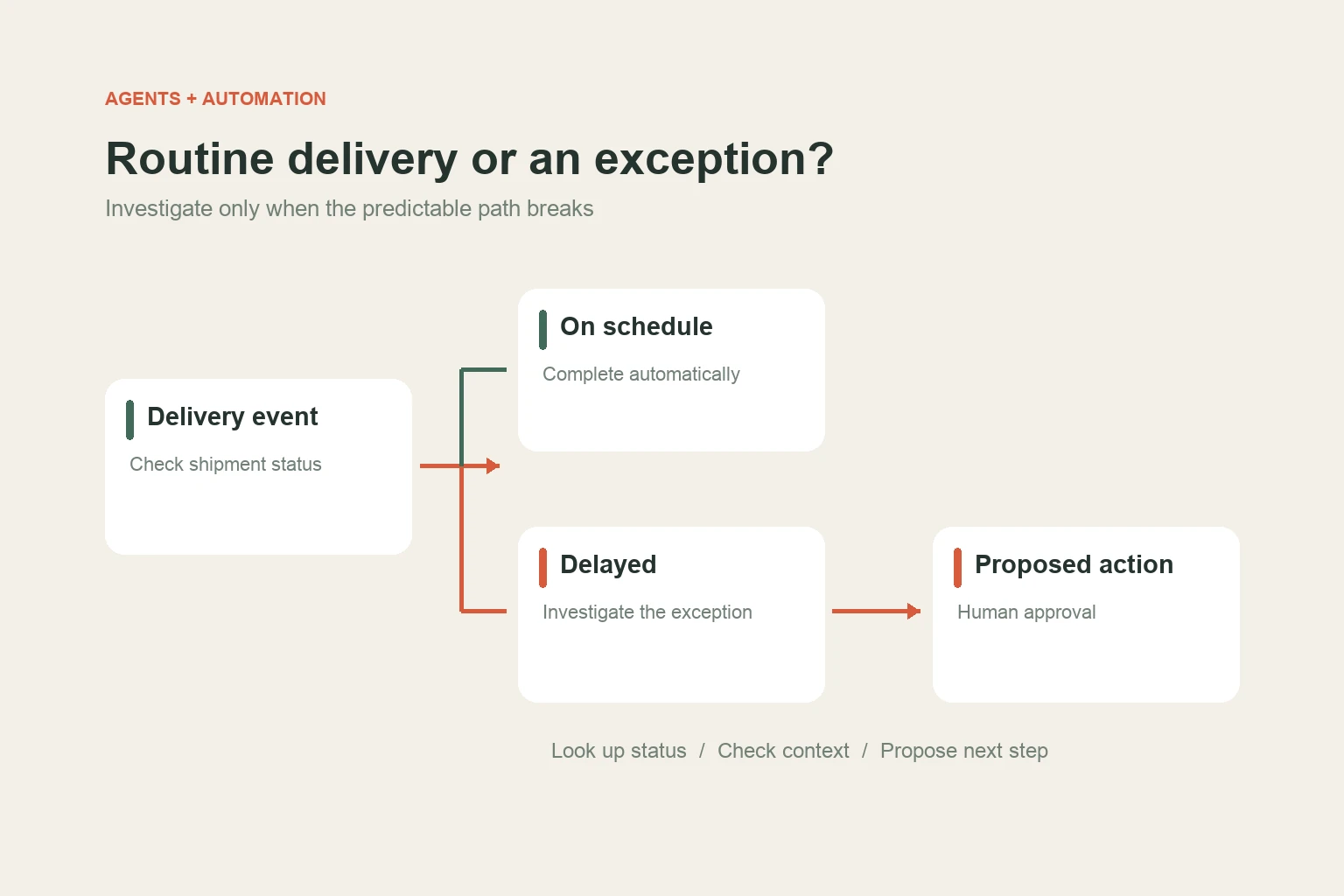
The useful question for an owner is more concrete: which part of the job changes from case to case? If a customer pays an invoice, sending a receipt is a known step. If a customer asks an ambiguous question about a delayed delivery, someone must interpret the request before deciding what to do. These are different problems, even if both appear in one process.
Three approaches, three kinds of work
Anthropic’s architecture guidance distinguishes predefined workflows from agents that choose their own process and tools. It also recommends increasing complexity only when simpler approaches cannot meet the task. Use that distinction when reviewing proposals, because “agent” is often used for several different designs.
This comparison is a suggested decision framework, not a benchmark. A workflow can contain an AI model without handing that model control over every step. Likewise, a successful agent may call ordinary workflows for actions that should remain predictable.
An example from a busy sales inbox
Consider an illustrative kitchen supplier. A web form already gives the customer’s name, email and product choice. A rule can create a lead and notify the right salesperson. Asking a model to invent that route adds little value.
A free-form email is different. An AI step might identify the requested product, flag a missing measurement and propose a reply. The surrounding workflow still decides where the draft is saved and who checks it. A person approves any price or delivery commitment.
Only after those steps work might an agent be useful for investigating a more complex enquiry. It could read a permitted product catalogue, check an approved stock tool and assemble options. It should not gain access to refunds, account changes or bulk emails just because it can reason.
Write the proposed tool permissions in ordinary language. “Read stock for this product” is clearer than “access the ERP.” A narrow permission gives the owner something concrete to accept and the implementer something concrete to enforce.
A pilot that gives you useful evidence
- Choose one recurring task and name its owner.
- Collect representative examples, including missing information and unusual requests.
- Record the current handling time, rework and unanswered cases.
- Test the simplest design first, with no consequential action executed automatically.
- Measure completed outcomes, correction time and total running cost.
- Expand access only when the evidence supports the next action.
Count a case as successful only when the downstream work is correct. A fluent draft that sends someone to the wrong queue is a failure. Keep a separate count for cases correctly escalated to a person; escalation can be the right result.
Your pilot should produce a short decision: keep the rule-based version, add one AI step, or justify an agent with specific evidence. Read our AI versus workflow automation guide for a related starting checklist.
Questions to ask before buying
Will an agent replace our existing systems? It may work through them, but you still need reliable records and clear ownership. Start by identifying the tools you intend to keep.
Is more autonomy always better? No. Autonomy is useful when it solves variability in the task. It also expands what must be tested and monitored.
What should the supplier demonstrate? Ask for real task examples, failure cases, the permission boundaries, an escalation route and a way to stop the process. A polished demo alone does not answer those questions.
Sources and further reading
Primary sources checked on 3 October 2026. Product announcements describe vendor plans and capabilities; availability and results depend on the implementation.
- Anthropic: Building effective agents
19 December 2024 - Salesforce: Trusted Enterprise AI Harness
11 September 2026